About Solar Sea Psychotherapy
Listening to your whole being,
not just your words.
Solar Sea Psychotherapy is a solo-practitioner private practice offering depth-oriented and somatic approaches for trauma resolution and menstrual cycle support. It’s a place for those who have been carrying too much for too long.
In the Solar Sea, the body is central to the healing process because the trauma isn’t the event you experienced, or the story you tell about it. It’s the lasting impact the experience has on your body and nervous system. Feeling on edge or disconnected, or constantly bracing for something bad to happen, are viewed here as protective responsive, not a flaw. In fact, a traumatized body isn’t broken, it’s highly specialized, active, and overworked. And it has the capacity to heal.
Integrating Jungian psychodynamic therapy and Somatic Experiencing® techniques, Solar Sea Psychotherapy offers specialized trauma treatment support for the mind and the body. A psychodynamic attachment-informed approach targets the psychological and relational imprints of trauma, while somatic techniques help resolve physical symptoms. Together, they create a balanced top-down and bottom-up approach.
What You Can Expect
About the Founder of
SOLAR SEA
PSYCHOTHERAPY

-
Deep Dreamer.
Sun Seeker.
Ocean Dweller.
Whole-Hearted Psychotherapist.
Chance is a Licensed Professional Counselor and Somatic Psychotherapist located in in Portland, Oregon.
She is endlessly curious about the various ways people speak with their whole being and not just their words.
She understands that there is more to talk-therapy than just talking, which is why she pursued intensive training with Somatic Experiencing® International. Her body-first approach works gently with the effects that traumatic experiences have on the body as well as the mind.
She listens deeply for parts of the self whose voices have been quieted by the well-intentioned, and lovingly protective, talkative mind.
-
Chance is a professional counselor licensed by the Oregon Board of Licensed Professional Counselors and Therapists.
She has completed two years of specialized training program with Somatic Experiencing® International to further refine her skills in treating trauma.
-
Chance worked as a therapist for the Early Assessment Support Alliance (EASA) in Portland, Oregon, where she provided psychotherapy and formal diagnostic services to young adults experiencing first-episode psychosis.
Additionally, she provided counseling to adolescents in a rehabilitation program who had been adjudicated for sexual offenses. -
No two people are the same! For that reason, Chance combines three core modalities to create a personalized therapeutic approach for each client:
Psychodynamic (Jungian)
Somatic psychotherapy
Attachment-Focused
She also draws on Internal Family Systems (IFS) and Acceptance and Commitment Therapy (ACT).
-
Licensed Professional Counselor (#C8066).
Master’s degree in Clinical Mental Health Counseling from Portland State University.
Received her Advanced I Level Certification in Somatic Experiencing.
Received formal training by Rick Johnson, Ph.D, a licensed psychologist and family therapist with over 30 years of clinical experience.
Core Values
Authenticity | Honesty
Safety | Transparency
Empowerment | Compassion
Agency | Autonomy
Curiosity | Wonder
Areas of Expertise

Attachment & Developmental Trauma
A traumatized body isn't broken; it's highly specialized, active, and overworked.
-
Solar Sea Psychotherapy understands that trauma is not the event itself, but the lasting physiological, psychological, and behavioral impacts of a past experience that was either:
Too fast, too soon,
Too much for too long,
Or not enough for too long
-
Acute trauma results from a single overwhelming event, such as an accident, sexual assault, physical attack, or natural disaster. The nervous system is flooded all at once, often leaving lasting imprints that can resurface as flashbacks, anxiety, hypervigilance, or heightened startle responses.
Attachment/developmental trauma (sometimes referred to as Complex trauma or Complex PTSD) develops through repeated or prolonged exposure to distressing experiences, such as childhood neglect, ongoing abuse, or chronic relational instability. Instead of one defining incident, it is the accumulation of many moments that overwhelms the body’s capacity to cope. This duration often shapes a person’s sense of self, their relationships, and their view of the world in deeply ingrained ways.
Both types of trauma can profoundly impact the nervous system, emotions, and behavior. Renegotiating trauma involves not only processing the effects of past events, but also restoring a felt sense of safety and agency in the present.
-
While attachment and developmental trauma is my speciality, my foundational training is in treating acute trauma. I continue to support clients with this experience.
-
While each person is multifaceted and will present in their own unique set of symptoms, there are some common patterns that can develop in response to attachment/developmental trauma, such as:
Difficulty feeling safe, even when life is stable.
Relying on others to feel safe or secure.
Pulling away from others, or finding it hard to connect.Fear of being “too much,” “not enough,” or eventually abandoned.
Difficulty trusting others, or expecting disappointment.
Recurring patterns of emotionally unavailable or unsafe relationship dynamics.
Trouble identifying feelings, needs, or preferences, especially in relationships.
When under stress, may sometimes feel younger than one’s current age.
Feeling disconnected from a sense of self, or “fragmented.”
Difficulty with emotional regulation and self-soothing.
Hypervigilance, including scanning for cues of danger in tone, facial expressions, or environment.
Chronic shame, self-blame, or a harsh inner critic.
A sense of helplessness or “stuckness”.
Dissociation or “checking out”.
Difficulty resting or sleeping.
Difficulty receiving care, or asking for help.
Difficulty experiencing pleasure or positive emotions.
Strong body-based symptoms, especially in response to relational stress.
Perfectionism, over-control, or relentless self-improvement.
Persistent loneliness, even around others.
Sensitivity to rejection, criticism, or conflict.
Difficulty with boundaries, saying no, or asking for needs to be met.
Feeling responsible for other people’s emotions.
People-pleasing or over-functioning to maintain connection.
-
When the surge of survival energy needed by the body for self-defense is prevented from expressing itself during a distressing event, this energy “get’s stuck” in the body without a path to release.
Over time, muscles begin to tense and chronic bracing becomes the default state of the body. The sun's rays against your face may no longer feel joyful. The people around you may seem distant or untrustworthy. The beauty in the world becomes more difficult to see as your perception of threat sharpens and your thoughts about danger become more solidly entrenched.
Curiously, many of our animal friends will literally "shake off" a life-threatening encounter with a predator as a way of releasing this energy.
A body marked by trauma has difficulty relating to its current surroundings because it was unable or prevented from “shaking off” (or discharge) that energy needed to protect it self.
As a result, the nervous system becomes highly skilled at detecting threat, but less practiced at noticing signs of safety.
The process of relating to the body naturally brings us into connection with the present-moment instead of the past.
While psychotherapy may revisit past experiences, the somatic approach simultaneously orients the body to the present moment so that the body instinctively begins to recognize safety and feel a bone-deep sense of its own survival.
-
The approach Chance uses is not intended to fix, cure, or get rid of anything. It is intended to help you relate to your body and find gentle, creative, and natural ways of releasing “stuck” survival energy.
This is because a traumatized body isn’t broken; it’s highly specialized, active, and overworked. It also has the capacity to heal itself.
You are not “overreacting”, you’re experiencing a natural function of the body that has been historically minimized. Your symptoms are meaningful signals that are deserving of compassionate and non-stigmatizing care.
Menstrual Cycle Related Mood & Somatic Symptoms.

-
Recurring emotional and body-based challenges that follow a cyclical pattern across the menstrual cycle.
-
This can include mild-severe shifts in mood, anxiety, irritability, or overwhelm, alongside physical or somatic experiences like sleep disruption, fatigue, heightened sensory sensitivity, and physical tension.
-
No, it is not just “bad PMS”.
PMDD is a diagnosable cyclical hormone-based mood disorder that can be highly disruptive and bring on severe mood changes such as:
Depression
Anxiety
Irritability
Rage
Feeling out of control
Suicidal thoughts
PMDD symptoms typically emerge within days of ovulation, bringing sudden shifts in mood, energy, and physical well-being. They often peak the week before a period and ease once bleeding begins.
Although people with PMDD tend to have balanced hormone levels, the brain is thought to be more sensitive to these natural fluctuations for reasons that are not yet fully understood.
-
Premenstrual Syndrome (PMS) is a common response to fluctuating hormones. For many people, this looks like cramps, bloating, breast tenderness, headaches, or irritability in the week before menstruation. It can be uncomfortable, but it usually doesn’t seriously disrupt daily life. This is a natural experience that many menstruating people experience, not a diagnosable condition.
Premenstrual Dysphoric Disorder (PMDD) is a severe and often debilitating medical condition characterized by experiencing severe mood and physical symptoms that can disrupt a person’s ability to work, go to school, or maintain important relationships. Symptoms occur exclusively during the luteal phase, or the premenstrual phase of the menstrual cycle, and subside within a few days of menstruation.
Premenstrual Exacerbation (PME) refers to the premenstrual exacerbation of the preexisting symptoms of another disorder. This is not a diagnosable condition, but an important clinical factor to inform treatment.
-
When people initially seek support for menstrual cycle–related mood challenges, they often have already been swept out to sea and are longing for solid ground.
Together, we’ll begin by exploring how your cycle affects your daily life and what you’ve already tried to ease the struggle. Simultaneously, we’ll focus on creating stability and finding relief so you feel less overwhelmed.
Along the way, you’ll gain a deeper, non-stigmatizing understanding of how the menstrual cycle and mood are connected. Chance helps reframe symptoms as meaningful signals from the body rather than a pathology.
She also uses menstrual cycle awareness (MCA) as a way to build curiosity, compassion, and trust in your body. This practice involves tracking your cycle, noticing your unique patterns, and aligning your activities with your body’s natural rhythms. You’ll also learn practical strategies to move through more difficult phases with greater steadiness and ease.
The Connection Between
Trauma & PMDD
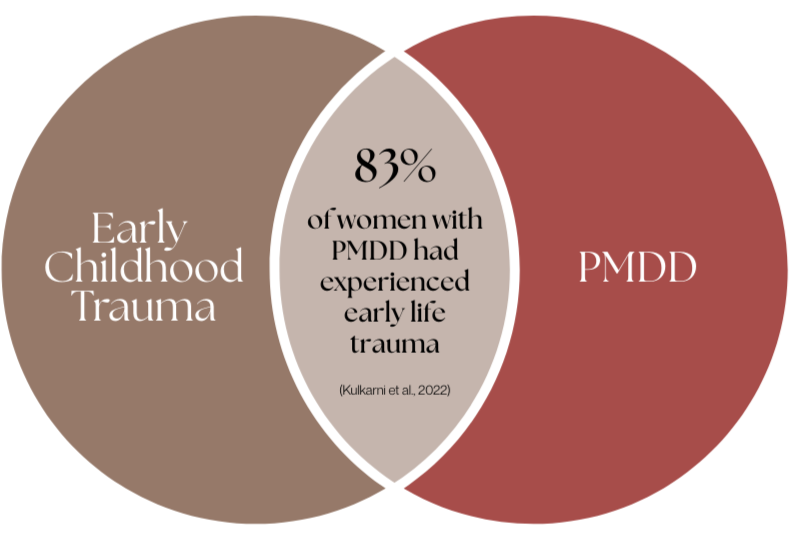
Research has consistently shown a connection between trauma and menstrual cycle disorders. Exactly how they are linked is still being studied, but for many people living with PMDD, early life trauma is part of their story.
Dreams &
Nightmares
Our nighttime dreams are windows into our inner world, reflecting both the challenges we face and our greatest possibilities.
-
Dreams can offer a glimpse into parts of ourselves we may not always notice when we’re awake. They often reveal the “other half”, or the unconscious side, of an experience.
For example, you might celebrate your best friend’s engagement but later dream of slipping the friend’s ring into your pocket. Or you might decide not to apply for a promotion, convinced you aren’t qualified, and then dream your boss gives you a glowing performance review.
By paying attention to dreams, we can begin to see ourselves more fully, along with our own unrealized potential.
-
The only person who can truly know the meaning of a dream is the dreamer themself. Using various dreamwork techniques, I support the dreamer by cultivating a space of self-discovery where the dreamer’s own personal significance can emerge organically from within.
-
Dreaming happens whether or not we remember it. And dreams linger, much like memories, that though forgotten, move quietly beneath the surface, subtly shaping our day-to-day lives.
While remembering dreams can’t be guaranteed, many people notice that as they begin to pay attention, dreams gradually come into awareness.